
Use this flooring quote guide to compare materials, labor, prep, and warranties, then choose an estimate that fits your Northern Colorado home and budget.
Glue Down vs Floating Floors: Which Fits?
A new floor can look nearly identical from the top, yet perform very differently under daily life. That is why the glue down vs floating floors decision matters before you choose a color, plank width, or price point. The installation method affects how the floor feels underfoot, handles moisture, responds to seasonal changes, and holds up to active kids, pets, and furniture moving day.
For most homeowners, there is no universal winner. A floating floor can offer excellent value and faster installation. A glue-down floor can deliver a firmer, quieter, more permanent feel. The right answer depends on your product, subfloor, room conditions, and how you want your home to function.
Glue Down vs Floating Floors: The Real Difference
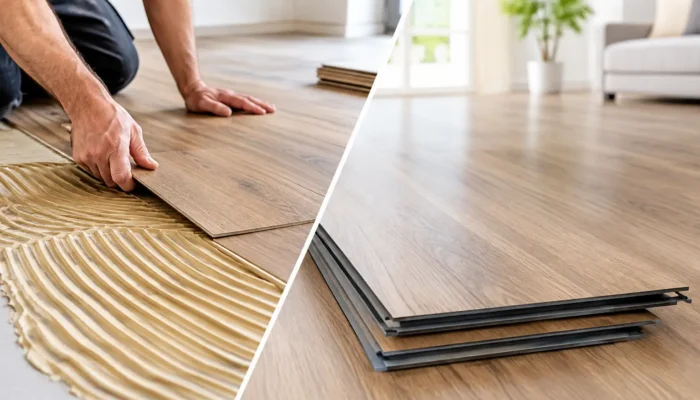
A glue-down floor is adhered directly to the prepared subfloor with a flooring adhesive. This installation is common with dry-back luxury vinyl plank and tile, certain engineered hardwood products, and commercial-grade resilient flooring. Once installed correctly, the flooring becomes closely connected to the surface below it.
A floating floor is not attached to the subfloor. Instead, the planks lock or fit together and rest over an underlayment or attached pad. Laminate, click-lock luxury vinyl, and many engineered hardwood floors are designed to float. The finished floor acts as one connected surface while retaining a small expansion gap around walls, cabinets, and other fixed objects.
Both methods can create a beautiful, durable floor. The key is using the method approved for the product and suitable for the home. Trying to save money by using the wrong installation approach can lead to gaps, movement, noise, lifted edges, or a warranty problem later.
When a Glue-Down Floor Makes Sense
Glue-down flooring is often the stronger choice when a homeowner wants a solid, stable feel. Because the material is adhered across the floor, it generally has less flex and movement than a floating installation. That can be especially appealing in large open rooms, busy hallways, kitchens, and spaces where the floor will see frequent traffic.
It is also a smart option for many concrete slabs, including basement areas, as long as the slab is properly tested and prepared. Moisture testing still matters. A waterproof luxury vinyl plank does not make the subfloor waterproof, and excess moisture vapor coming through concrete can compromise adhesives or contribute to other problems around the home.
Glue-down luxury vinyl can be a practical choice for households with dogs, children, and busy schedules. It is easy to clean, holds up well to everyday wear, and does not rely on a click-lock joint that may be stressed by a heavy rolling load or an uneven subfloor. In a room with lots of furniture, a glue-down floor can feel especially secure.
There are trade-offs. Glue-down installation requires more subfloor preparation and more labor. The surface must be clean, flat, dry, and suitable for the adhesive. Installation can take longer because the adhesive needs to be applied correctly and given the appropriate time to set. Removing a glued-down floor later is also more involved.
That added preparation is not wasted effort. It is often what gives a glue-down floor its polished, long-lasting result. A professional installer can identify low spots, cracks, moisture concerns, and surface contaminants before they become expensive surprises.
When a Floating Floor Is the Better Fit
Floating floors are popular for good reason. They are typically faster to install, can reduce labor costs, and offer a wide range of attractive laminate, luxury vinyl, and engineered hardwood options. For homeowners refreshing bedrooms, living areas, dining rooms, or an entire main level on a budget, floating floors can offer a great balance of style and value.
Many floating products include an attached pad, which can make the floor more comfortable underfoot and help soften sound. Other products use a separate underlayment selected for the room and subfloor. That added cushion can be welcome in family rooms and upstairs spaces where comfort matters.
Floating floors also work well when future changes are likely. A click-lock floor may be easier to remove or replace than a glued-down surface, although repairs still require skill. If one plank in the middle of a floating floor is damaged, the installer may need to work back from a wall or use a specialized repair method to reach it.
The biggest requirement is a flat subfloor. Floating planks can bridge minor imperfections, but they cannot correct a floor that is out of level or uneven beyond the manufacturer’s limits. Too much movement beneath the planks can cause clicking, joint separation, or damage to locking systems over time.
Floating floors need expansion space, too. That is not an installation shortcut. Luxury vinyl, laminate, and wood-based products expand and contract with temperature and humidity changes. Proper perimeter gaps and transitions allow the floor to move as designed. If a floating floor is pinned under heavy cabinets, trapped by tight trim, or installed without room to expand, it can buckle or peak.
Compare Feel, Sound, Cost, and Repairs
The difference between these two methods is most noticeable in everyday use. Glue-down flooring usually feels firmer and more connected to the subfloor. Floating flooring may feel slightly softer or have a subtle give, especially over an underlayment. Neither feel is automatically better. Some homeowners prefer the solid feel of glue-down vinyl, while others enjoy the added cushion of a floating floor.
Sound is another consideration. A well-installed glue-down floor can reduce the hollow or tapping sound sometimes associated with floating products. However, a quality underlayment and proper subfloor preparation can make a floating floor noticeably quieter. The product itself matters just as much as the installation method.
Upfront cost often favors floating floors because installation is generally quicker and uses less adhesive-related prep. But price should not be the only factor. If a slab needs extensive leveling or moisture mitigation, either option may require added work. A written estimate based on an in-home measure gives you a more accurate number than a per-square-foot price seen on a shelf.
Repairs depend on the material and the location of the damage. With glue-down vinyl, a skilled installer can often replace an individual plank or tile without taking apart the entire room. With floating floors, replacing a damaged board can be more complicated, but it is still possible in many cases. Keeping a carton of extra material from the original dye lot is a smart move with either installation.
Your Subfloor Should Lead the Decision
The floor beneath your new flooring has a major say in what will work. Plywood subfloors, concrete slabs, existing tile, and older flooring all have different requirements. A floating floor may be ideal over a stable existing surface, while a glue-down installation may require removal, patching, and leveling first.
Northern Colorado homes add a few local considerations. Dry winters, temperature swings, and basements on concrete can all affect flooring performance. Wood and wood-based products react to changes in humidity, while concrete must be tested for moisture even when it appears dry. A professional measure at home helps match the product and installation method to the conditions that actually exist in your rooms.
Do not assume a product labeled waterproof can go anywhere without preparation. Waterproof refers to the flooring surface, not necessarily to the seams, perimeter, adhesive, subfloor, or damage caused by a plumbing leak. In bathrooms, laundry rooms, entryways, and below-grade spaces, proper installation details matter as much as the product label.
How to Choose With Confidence
Start with how each room is used. For a busy kitchen or main living area where you want a firm, stable floor, glue-down luxury vinyl may be worth the added installation investment. For bedrooms, family rooms, and budget-conscious updates, a floating click-lock floor can be an excellent solution.
Then consider the subfloor, moisture conditions, and the product warranty. Not every plank is available in both installation formats, and manufacturers set specific rules for acceptable underlayment, adhesive, flatness, and moisture levels. Following those requirements protects your investment.
Finally, look at samples in your own home. Lighting, wall color, cabinetry, pets, and furniture all change how a floor looks and feels. Choice Floors Northern Colorado brings name-brand options to your home, measures the space, and provides practical recommendations without making you spend a weekend sorting through a showroom.
The best flooring choice is the one that fits your life after the installers leave. A clear plan for preparation, installation, and everyday use will do more for your satisfaction than choosing based on a display sample alone.

Related Posts


Comments (0)